
Type “Muslim travel Jamaica” into Google and chances are you are looking for the practical things first: Is there halal food in Jamaica? Are there Muslims in Jamaica? Is Jamaica Muslim-friendly?
All fair questions.
But the more interesting question might be this:
What if Islam in Jamaica is much older than most of us realize?
When people imagine Jamaica, they tend to picture reggae, waterfalls, jerk chicken, beaches and Rastafari. Islam rarely enters the picture.
And yet, buried beneath the more familiar story of the island is a remarkable history of African Muslims whose faith crossed the Atlantic with them under the most brutal circumstances imaginable.
Among the enslaved Africans brought to Jamaica were educated West African Muslims who could read and write Arabic, knew the Qur’an and continued to preserve elements of their religious and intellectual traditions while living under slavery. Scholars have documented Arabic autobiographies, religious writing and correspondence produced by Muslims enslaved in nineteenth-century Jamaica.
One of the most extraordinary was Abu Bakr al-Siddiq, an educated West African Muslim known in Jamaica as Edward Donlan. Alongside figures such as Muhammad Kabā Saghanughu, his surviving Arabic writings give us a rare glimpse into a world that has largely disappeared from popular memory: Islam lived, remembered and written on Jamaican soil.
Think about that for a moment.
Long before anyone was searching Google for halal food in Jamaica there were Muslims in Jamaica carrying verses of the Qur’an in their memories and Arabic in their pens.
That history is one of the reasons Jamaica has always meant something different to me.
How the Soul Rebel Journey Began
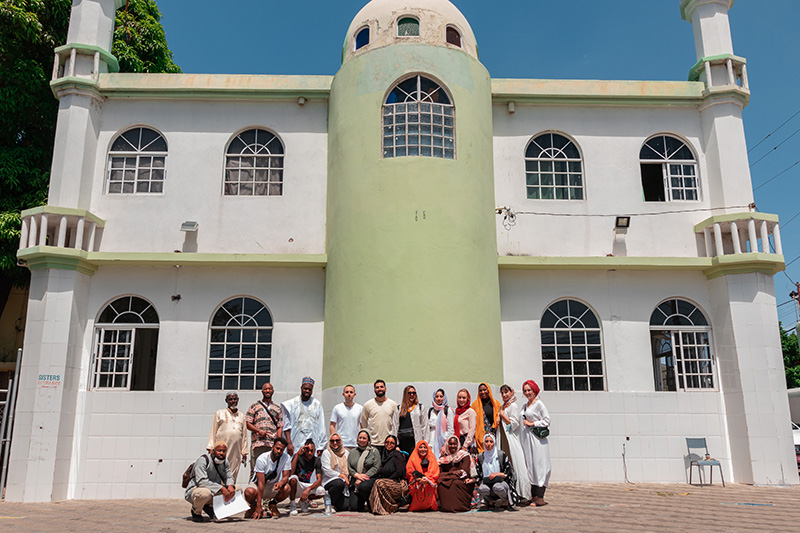
My own relationship with Jamaica began long before Burgundy Roots became what it is today. Our very first Burgundy Roots retreat took place there in 2014, after earlier travels had introduced me to the island and eventually to members of Jamaica’s Muslim community.
Years later, I joined Sacred Footsteps for a podcast conversation called Jamaica, Rasta-Muslims & The Importance of Meaningful Travel. We spoke about the Jamaican Muslim community, the fascinating meeting points between Rasta and Muslim identity, the ethics of tourism and why meaningful travel should take us beyond the walls of a resort.
Listen to the Sacred Footsteps conversation: Jamaica, Rasta-Muslims & The Importance of Meaningful Travel
That relationship changed the trajectory of our Jamaica retreats. Sacred Footsteps introduced me to historian and educator Mustafa Briggs, and from those conversations came an idea that felt almost obvious once we saw it: why not bring people to Jamaica specifically to uncover the history of Islam in the Caribbean?
The result grew into our Soul Rebel journeys—retreats where Mustafa joined Burgundy Roots in Jamaica to teach the history of Islam in the Americas and help travellers encounter a Caribbean story many Muslims had never been taught. Sacred Footsteps later described his Before Malcolm X: The History of Islam in the Americas lecture as being presented first to guests on its Roots & Culture Retreat in Jamaica in collaboration with Burgundy Roots.
And suddenly a Muslim-friendly tour of Jamaica meant something very different.
We Are Beyond Halal Travel
Burgundy Roots has never been interested in simply taking the standard vacation and adding halal food to it.
Of course those things matter. A Muslim traveller should be able to eat comfortably, pray comfortably and feel considered. Whether someone is looking for a Muslim-friendly travel agency, an Islamic trip, a Muslim women’s travel group or even a halal Caribbean holiday, those needs are real.
But they are only the beginning.
We are beyond halal travel.
For us, Muslim travel is not simply about asking:
Where can I eat?
It is also about asking:
Whose history happened here?
What stories disappeared?
Who lived, prayed, struggled and dreamed on this land before us?
That is why our Jamaica retreats have never been designed around foreign-owned all-inclusive resorts. Burgundy Roots has deliberately focused on locally rooted experiences, community tourism, local businesses and genuine encounters with the people and culture of the island.
We want our travellers to understand Jamaica—not merely consume it.
There Is Another Jamaica Waiting to Be Discovered
Yes, Jamaica is turquoise water, mountains, music, food and some of the warmest people you will ever meet.
But there is another Jamaica beneath the postcard.
A Jamaica where West African Muslims wrote in Arabic.
A Jamaica where Islam survived in fragments through slavery and displacement.
A Jamaica where contemporary Muslim communities continue to live and worship.
And a Jamaica whose history connects Africa, the Caribbean and the Muslim world in ways many travellers have never imagined. Academic work on the Muslim Caribbean now traces precisely these continuities between enslaved African Muslims, later South Asian Muslim communities and the wider development of Caribbean Muslim identity.
So when someone searches “Muslims in Jamaica,” “halal travel Jamaica,” “Muslim travel group” or “Muslim-friendly tour package,” I hope they find more than a list of restaurants.
I hope they find the story.
Because Burgundy Roots was never created simply to show Muslims where they can travel.
We want to show them what they might discover when they get there.
Beyond halal travel. Beyond tourism. Back to the roots.

About the Author
Wafa was born in Algeria and later moved to Canada with her family, growing up between Montreal and Toronto. A powerful encounter in Toronto’s Kensington Market inspired her to embrace her Muslim identity with pride and sparked a lifelong interest in Caribbean culture, reggae, and Rasta philosophy. As a history student at the University of Toronto, she became fascinated by the cultural and historical parallels between the Caribbean and the Middle East.